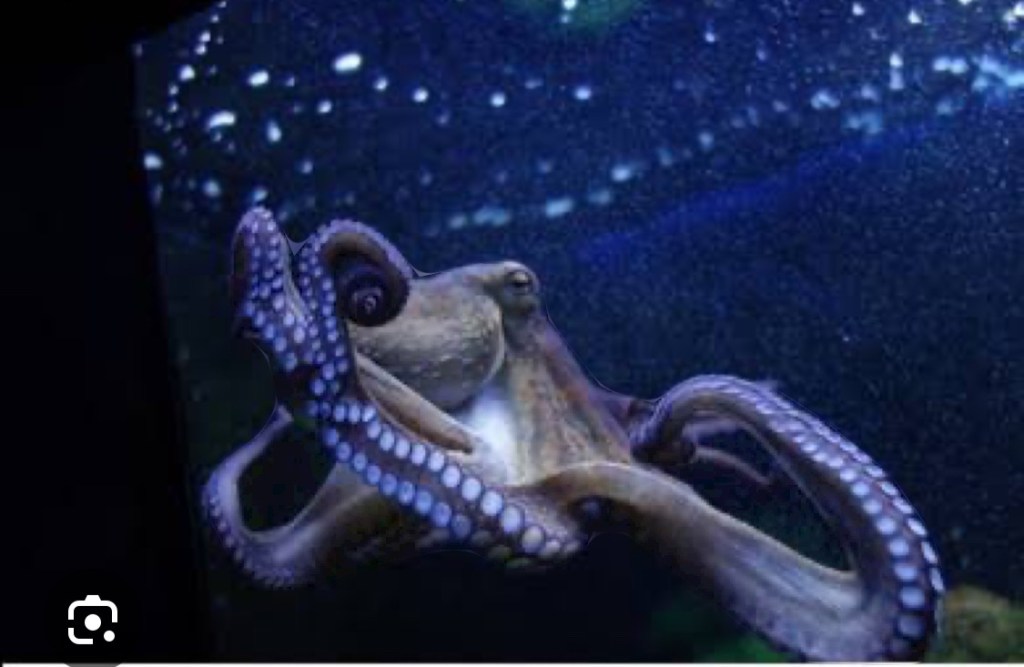
Drifting through the deep, a nearly invisible creature glides with ease. The glass octopus, a ghost of the open ocean, moves using jet propulsion—expelling water through its siphon to navigate the deep-sea currents.
Unlike other octopuses, he has no ink sac to shroud himself in darkness. Instead, his best defense is his near-transparent body, making him almost invisible to lurking predators. He will only live for two to five years, and in that time, he must outwit the dangers of the deep—pollution, climate change, and the ever-present threat of sharks.
At 3,000 feet below the surface, where sunlight barely reaches, life moves at a slow and patient pace. The little octopus drifts between towering mountains of seaweed and coral, his delicate body pulsing gently as he scans his surroundings.
Finding food is not easy. He hunts by touch, for his sight is poor. Crustaceans hide well among the coral, motionless and impossible to see. He reaches out, feeling along the rough surfaces, but finds nothing.
Then—a faint vibration. A slow, steady movement.
A snail, gliding across the rocky seabed.
The octopus extends a delicate arm and gently picks up his prize. It may not be much, but for tonight, it is enough.
In the silent, endless dark, the glass octopus continues his journey, a nearly invisible wanderer of the deep.
 Animalstories