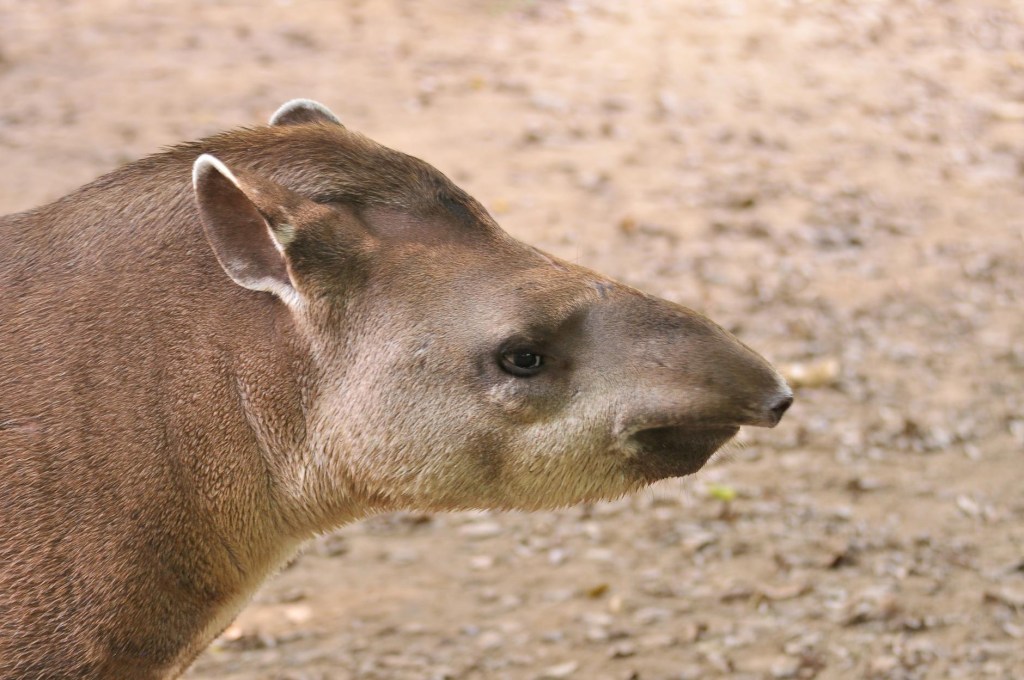
In the heart of the Amazon rainforest, where sunlight filters through the dense canopy, lived a solitary creature named Tupi, an Amazonian tapir. Tupi was a gentle giant, weighing around 500 pounds, with a stout body, short legs, and a distinctive prehensile snout that he used to grasp leaves and fruit. His dark, bristly hide allowed him to blend seamlessly into the shadowy undergrowth, making him a rare sight in the wild.
Tapirs are primarily nocturnal, and Tupi was no exception. As dusk settled over the forest, he would emerge from his resting place near a secluded riverbank to forage. His diet consisted of a variety of vegetation—leaves, twigs, fruits, and aquatic plants. His favorite treat was the ripe fruit of the fig tree, and he would often travel great distances to find these delicacies.
One evening, as Tupi wandered through a recently burned section of the forest, he noticed new shoots and saplings sprouting amidst the charred remains. Drawn by the fresh greenery, he began to feed, inadvertently trampling the ash-covered ground. Unbeknownst to him, as he moved and fed, he was dispersing seeds through his dung, playing a crucial role in the regeneration of the forest. Studies have shown that tapirs spend more time in previously burned areas, aiding in forest restoration by spreading seeds and facilitating new plant growth.
Despite his size, Tupi was an excellent swimmer. The Amazon’s rivers and streams were his refuge from predators like jaguars and caimans. On particularly hot days, he would submerge himself, leaving only his snout above water to breathe, while small fish nibbled away parasites from his thick skin.
Tupi’s solitary existence was occasionally interrupted during the mating season. After a gestation period of about 13 months, female tapirs give birth to a single calf. These calves are born with striking white stripes and spots that provide camouflage against the dappled forest floor. As they mature, this pattern fades, and they take on the uniform dark coloration of adults.
The Amazon rainforest was not just Tupi’s home; it was a delicate ecosystem where each species played a vital role. Tapirs like Tupi were essential gardeners of the forest, their foraging habits helping to maintain the biodiversity that made the Amazon so unique.
However, the encroachment of human activity threatened this balance. Deforestation and habitat fragmentation posed significant risks to tapir populations. Conservation efforts were crucial to ensure that creatures like Tupi continued to roam the forests, maintaining the ecological harmony of the Amazon.
As night deepened, Tupi retreated to his secluded spot by the river, the sounds of the jungle lulling him into a restful sleep. His presence was a testament to the intricate web of life that thrived beneath the emerald canopy—a reminder of the wonders that the Amazon held and the importance of preserving it for generations to come.
 Animalstories